mistakes to avoid
Wedding Cake Delivery Mistakes That Cause Tiers to Collapse
Collapsed wedding cakes usually fail for the same handful of reasons: no internal support, warm buttercream, a sloped car floor, and a cake stacked at the shop instead of on the venue table.
Stacking without dowels, straws or a center rod
Gravity and travel do not forgive a naked cake stack. The pressure from even a well-leveled top tier will quickly squeeze the lower layers without internal support. As the vehicle takes corners or hits a bump, the cake's own weight can cause tiers to tilt, slide or crush each other. The result is often a lopsided cake, bulging buttercream, or a full collapse.
Dowels, drinking straws, or a center rod distribute the weight of upper tiers away from the soft cake. Most shops use food-safe wooden or plastic dowels cut to height for each layer. Some bakers prefer a single long rod through the core for added security, especially for taller stacks. The key is to measure each support to match the cake's actual height once filled and frosted, not just the planned height from the recipe. Too short, and the upper tier presses into the cake below. Too tall, and the cake floats or wobbles, risking a sudden shift in transit.
Some bakers skip supports for smaller cakes: a two-tier cake under twelve inches high may not always show trouble in a short ride. But for wedding cakes of three or more tiers, the risk is not worth it. Internal support is never optional once the cake leaves the bench.
Keep reading: Allergen Labeling and Cross Contact Rules for Cake Orders
Cake boards cut to the wrong diameter for the tier above
Every tier needs its own board, sturdy, greaseproof, and cut to match the diameter of the cake. If the board is too small, the soft edge of the cake overhangs the support, and the tier can droop or split. If the board is too large, the visible lip makes stacking messy. It can also create air gaps when stacking, and buttercream can crack or slide during transit as the cake shifts unevenly.
The board must be thick enough to hold the weight of the cake plus any decoration. A single cardboard round may buckle under a heavy fruit cake or fondant finish. Most bakers double up lightweight boards or use masonite for bottom tiers. It is worth checking that every board fits snugly within the footprint of the cake above and below, no more than a quarter inch of difference on any side.
Before stacking, some use a dab of buttercream or royal icing between the board and the cake below to anchor each tier. This layer glues the cake in place and helps prevent sliding on the way to the venue.
Assembling all three tiers at the shop, then driving across town
The temptation to finish the cake at the shop is strong. Lighting, tools and time are all on your side. But once a fully stacked cake leaves the controlled environment of the bakery, it is at the mercy of potholes, sudden stops, and tight corners. Even with perfect doweling, a stacked cake is vulnerable to sideways force. The taller the stack, the more leverage every jostle has on the base.
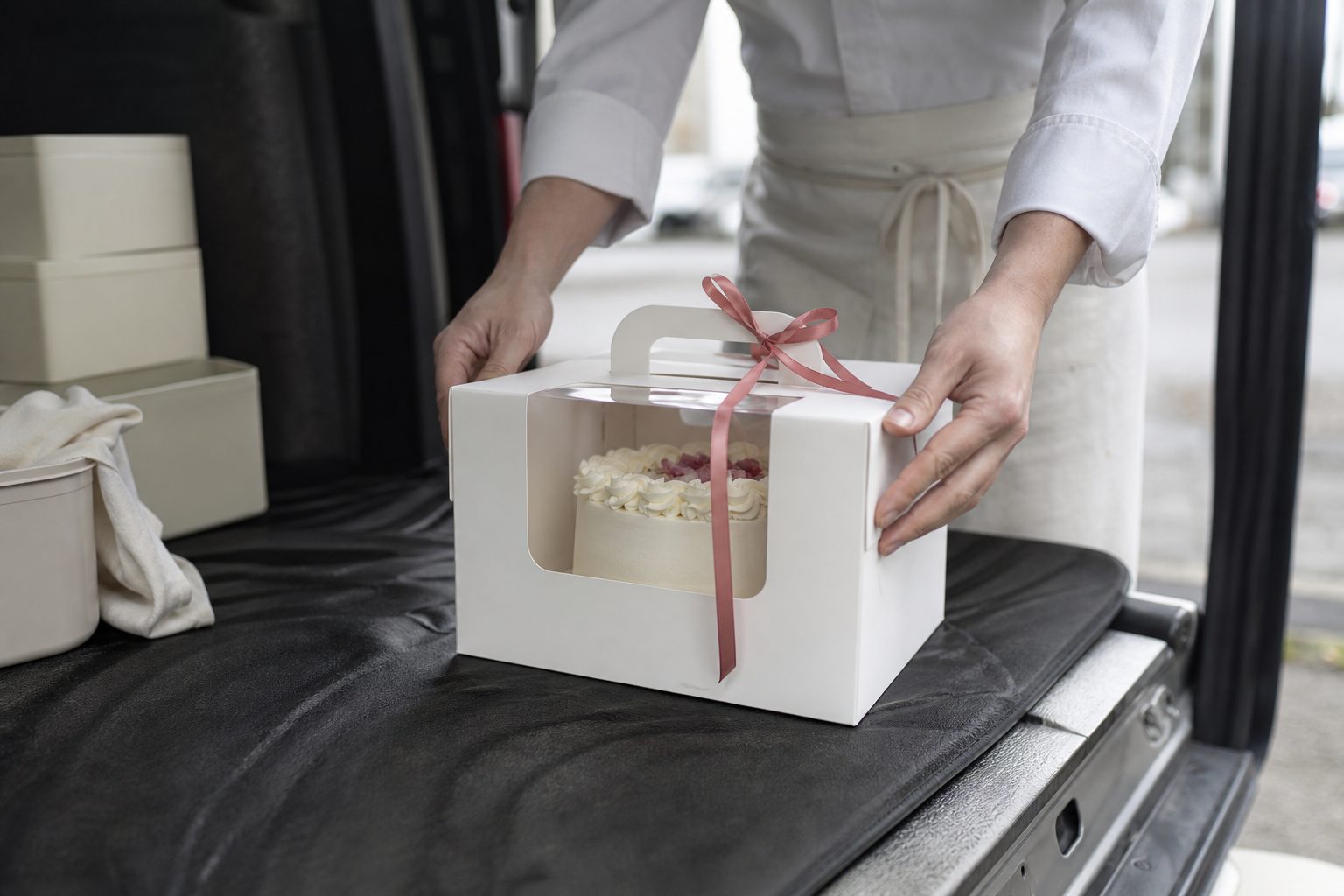
Most bakers now transport large cakes in sections. Each tier rides in its own box, resting on a flat surface. Stacking and finishing happens at the venue, after the cake is safely inside. For two-tier cakes, some still risk a pre-stack for short trips on smooth roads, but three or more tiers almost always require on-site assembly. This approach also limits the visible seams and touch-ups needed after delivery. Fondant or buttercream finishes are less likely to show cracks, and the structure holds up better in the new environment.
On rare occasions, such as venues with no set-up space or tight time constraints, bakers may transport smaller three-tier cakes fully assembled. This is always a calculated risk and demands flawless support, careful packing, and a slow, steady drive.
Loading the box on a sloped car floor or a seat instead of a flat surface
Most delivery vans and personal vehicles have uneven cargo areas. Car floors usually slope toward the back seat, and seats themselves are no better. Placing a cake box on a slanted surface can cause the entire cake to lean, slide, or even tip over during travel. The soft buttercream or fondant will not hold against gravity for long, and the internal supports are designed for vertical weight, not lateral force.
The safest option is a flat, non-slip surface. Many bakers keep a sheet of plywood or a dedicated cake transport board in the car. Non-skid mats help keep boxes in place. For single cakes, some use a crate or a box lined with towels to build up a level surface. Larger cakes may need a second person to steady the box on turns and stops. It is never wise to balance a cake on a seat, even for a short trip across town.
Securing the box also matters. Doors opening, hard braking, or a sudden stop can all send an unanchored cake flying. Bungee cords or seat belts can hold a box in place, but always check that these do not crush the sides or lid and touch the cake itself.
Keep reading: Costing a Three Tier Wedding Cake From Flour to Delivery
Cabin temperature: chilled cake, condensation and a buttercream that softens
Temperature changes hit cakes hard. A cake chilled overnight for stability will sweat as soon as it hits a warm car or humid air. Buttercream and fondant both attract moisture, which can turn a crisp finish gummy or streaked. If the cabin is too warm, buttercream softens, and the cake can sag or shift in transit. If it is too cold, condensation inside the box forms as the cake warms up, causing sticky patches or even wet streaks on the finish.
Chilled cakes and condensation
Transporting a cake straight from the fridge is common, but the box should be kept closed until the cake reaches room temperature. This limits condensation. Opening the box in a humid car lets moist air touch the cold cake, leading to droplets and sticky surfaces. Some bakers run the car's air conditioning for several minutes before loading the cake, so cabin and cake temperatures are closer.
Buttercream and softening
Buttercream made with a high butter ratio will begin to melt above room temperature. Short drives in summer require a cool cabin. For longer trips, some bakers use insulated containers or dry ice packs alongside, but never touching, the cake box. Avoid direct airflow from vents, as this can dry out or spot the finish. The goal is to keep the cake cool but not cold, steady but not hard. A thermometer in the car helps monitor conditions for each delivery.
Arriving before the venue table is set, leveled and out of the sun
A wedding cake needs a solid, level display. Venues sometimes set up tables late, or miss leveling on uneven floors. Delivering before the display table is ready means the cake sits in the box, risking temperature swings or accidental bumps as other staff move furniture around. Bakers who go ahead and stack on an unsteady table see tiers shift, seams crack, and decorations slide as the cake settles into a slant.
It is best to coordinate with the venue or planner for a set delivery window. Before stacking, always check the table for wobble, tilt, and direct sunlight from windows or outdoor doors. Many shops carry a small spirit level just for this step. If the table is not ready, it pays to wait or request a more stable spot. Sunlight and heat can ruin hours of work in minutes, especially for buttercream cakes in summer or under glass windows.
Some bakers lay a non-slip mat or thin foam under the cake board for extra security. This helps guard against minor shifts if the table is jostled during setup or display.
See how TieredOrders handles this for bakeries
Leaving without a repair kit, spare buttercream and an offset spatula
Even the best-packed cake can suffer a ding, smudge, or crack on the way to the venue. A repair kit is basic insurance. Most kits include a piping bag filled with matching buttercream or royal icing, an offset spatula, a small paring knife, extra dowels, scissors, and a clean towel. Some bakers add a set of gloves, a soft brush for loose crumbs, and a small bottle of alcohol for cleaning up sugar work or fondant details.
Many cakes need a quick touch-up after stacking: filling visible seams, blending frosting, or reattaching decorations. Without the proper tools, these fixes are slow and obvious. The offset spatula is especially important for smoothing edges and hiding joins. Leftover fondant or gum paste flowers can also save the day if a decoration breaks or goes missing in transit.
Some shops pack their repair kit in the same box as the cake, while others keep it in the delivery vehicle for every order. The kit should be checked and restocked after each delivery to avoid a last-minute scramble before the next job.
Fixing a shifted tier on site without restarting the finish
Even with careful stacking and support, a tier may slide off center during transport or setup. Rescuing a shifted tier at the venue without ruining the finish requires patience and practice. First, assess how far the tier has moved and whether the internal supports are still in place. If the tier is only slightly off, a gentle nudge with clean hands or a spatula can move it back. For larger shifts, it may be necessary to lift the tier off, reposition the dowels, and restack.
To minimize damage, use an offset spatula or bench scraper to loosen the tier from the buttercream below. Avoid pulling or twisting, as this can tear the finish and expose the cake. If the board is glued down with buttercream or royal icing, slide a paring knife under the board edge and work slowly. After repositioning, reapply buttercream to the seam and blend with a spatula. Minor cracks or dents can be patched with extra frosting or a piped border. If fondant decorations are knocked loose, use a dab of royal icing or melted chocolate to secure them.
Most important, do not panic. Wedding days are stressful, but a measured approach and a well-stocked repair kit solve most on-site problems. With extra time and the right tools, the cake can still look flawless for photos and guests.
Getting it right: reliable order intake and production planning
Many collapsed wedding cakes start with small oversight: a missing support, a rushed assembly, a skipped equipment check. The best defense is a clear process: order forms that specify size, tier count, delivery window, and finish; pricing rules that account for added labor or materials; and a production calendar that keeps deadlines visible for the whole team. Custom cake shops now rely on digital forms and planning tools that help prevent these mistakes. With the right intake system, support plans and delivery notes stay front and center, and every team member knows what to prep. For shops that want to avoid collapse, on delivery day or in the books, these tools make all the difference.