comparison
Buttercream, Fondant and Ganache Compared on Cost, Heat and Labor
Fondant costs more per covered tier than buttercream but survives an August tent. A working comparison of the three standard finishes on ingredient cost, labor hours, heat tolerance and on site repair.
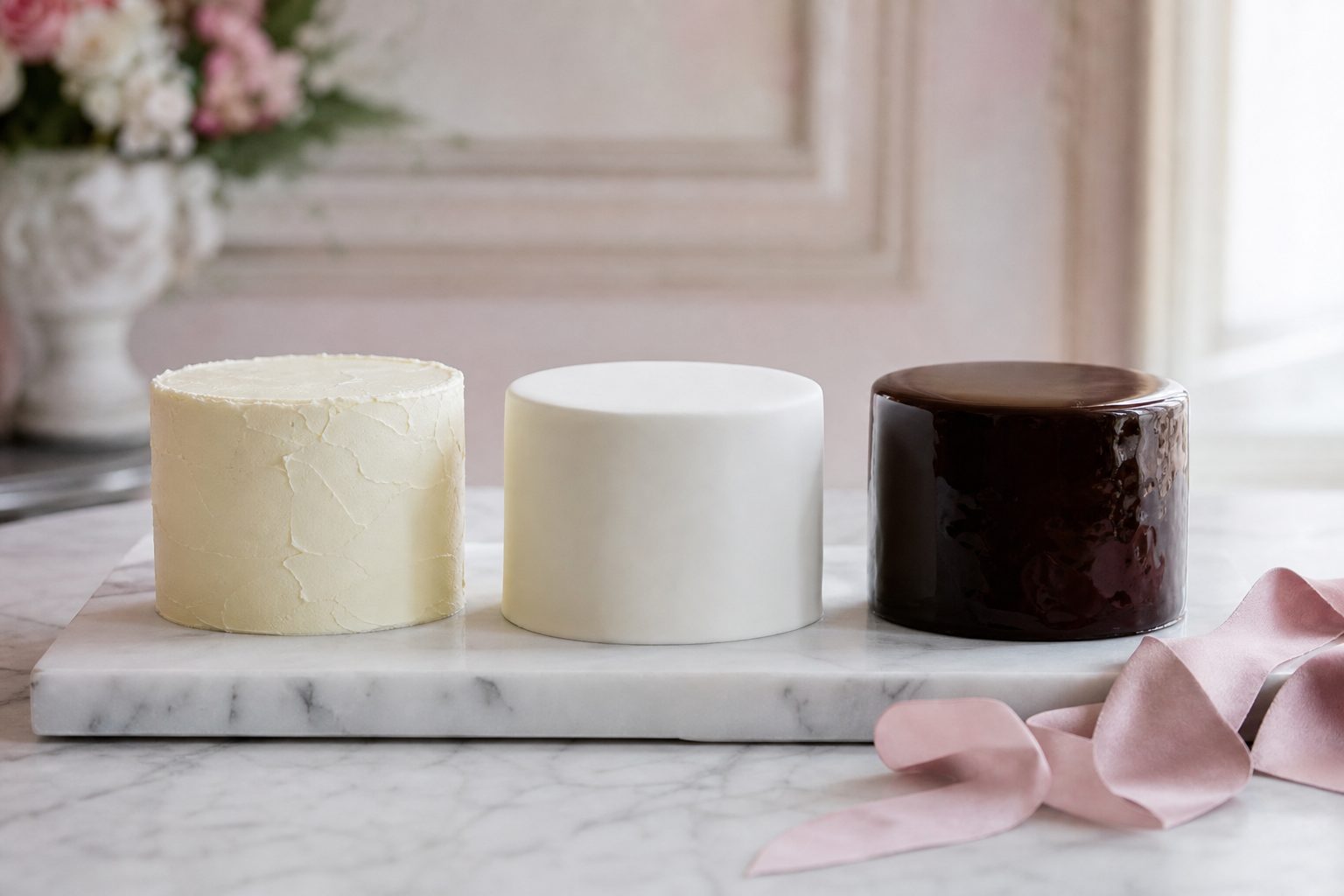
What each finish actually is: meringue buttercreams, rolled fondant, whipped ganache
Buttercream, fondant, and ganache are the standards for finishing custom cakes, yet each brings its own demands and strengths. For cake decorators and bakery owners, knowing what you're working with is the start of accurate pricing and honest consultation.
Meringue buttercreams, whether Swiss or Italian, blend egg whites with sugar, then whip in butter. The result is silky, stable, and smooth, less sweet than American buttercream. This finish takes color well and can be piped or smoothed for a clean modern look.
Rolled fondant is a sugar paste, kneaded and rolled flat, then draped over a cake. It's made from sugar, water, gelatin, and often an invert sugar like glucose or corn syrup. Once on the cake, it firms up, creating a matte, dense shell that can be shaped, cut, or textured. Fondant is favored for wedding cakes with sharp edges, dramatic colors, or intricate decoration.
Whipped ganache begins with chocolate and cream, cooled and whipped to an airy spread. Ganache can be poured as a glaze or spread thick as a finish. Dark chocolate ganache offers a bittersweet contrast to sweeter cake and stands up to sculpting, though it lacks the flexibility of fondant and the lightness of buttercream.
Keep reading: Wedding Cake Delivery Mistakes That Cause Tiers to Collapse
Ingredient cost per covered tier at typical pan sizes
Ingredient costs factor into every quote, especially as prices for eggs, butter, and chocolate fluctuate. Most custom cakes use tiers from six inches to twelve inches in diameter, with heights around four to five inches. The cost per tier scales with both ingredients and finish thickness.
- Meringue buttercream: Butter and eggs are the main expense. Covering an eight-inch tier (about five inches high) requires around one and a half pounds of buttercream. At current wholesale prices, that's a moderate outlay, but still less than fondant or ganache. Flavored or colored buttercreams may push cost slightly higher.
- Rolled fondant: Fondant itself is pricier per pound than buttercream ingredients. For an eight-inch tier, expect to use at least one and a quarter pounds, plus a base layer of ganache or buttercream underneath. Bulk fondant can help control costs, but even so, fondant typically runs higher per tier than buttercream.
- Whipped ganache: Ganache relies on heavy cream and quality chocolate, both of which have climbed in price. Covering an eight-inch cake with a thick ganache layer uses up to one and a half pounds of chocolate and cream combined. White and milk chocolate ganache costs even more. Ganache tends to land between buttercream and fondant on ingredient expense, but dark chocolate can sometimes nudge the top.
Buttercream remains the least expensive, with fondant the priciest, and ganache often splitting the difference but highly sensitive to chocolate choice.
Labor hours from crumb coat to a finish you would photograph
The finish you can photograph and sell is never just a swipe of frosting. Real labor includes crumb coating, chilling, smoothing, and any detail work.
- Meringue buttercream: After crumb coating, a bakery can chill and apply a thick finish. Getting a sharp edge with buttercream requires at least two or three passes, with time for chilling in between. A single eight-inch tier from base to photo-ready can take an hour for a skilled decorator, longer for complex colorwork or piping.
- Rolled fondant: Fondant demands a flawless undercoat, either buttercream or ganache, smoothed and chilled. The fondant is rolled, lifted, and draped, then trimmed and smoothed. Covering and finishing an eight-inch tier often exceeds one and a half hours, especially with sharp edges or complex embossing. Fondant allows some elements to be made in advance, but the hands-on time adds up.
- Whipped ganache: Ganache is poured or spread over a crumb-coated cake, then smoothed with a spatula or scraper. Achieving a perfectly even layer takes practice. For a single tier, ganache generally ties buttercream in labor, though the need for precise temperature control can slow things down. Poured ganache for a drip effect is faster, but full coverage and smoothing add time.
Fondant leads in labor hours, while buttercream and ganache are close, with ganache gaining complexity as tier count rises.
Keep reading: Allergen Labeling and Cross Contact Rules for Cake Orders
Heat, humidity and the outdoor summer reception
Most disputes over finish start here: a tent wedding in July, cakes set out for hours, and a finish that slides mid-photos. Knowing the limits saves reputation.
- Meringue buttercream: Butter melts near room temperature. In heat above seventy-five degrees, buttercream softens, sags and can slide. Humidity does not help, though refrigeration before delivery can buy time. For outdoor events, meringue buttercream is a risk unless the cake will be displayed and served quickly.
- Rolled fondant: Fondant sets firm and resists heat much better than buttercream. It acts as a barrier, slowing buttercream melt underneath. In humid conditions, fondant can begin to sweat, but rarely loses shape unless it rains directly onto the cake. For summer tent receptions, fondant is the safer bet for structure and presentation.
- Whipped ganache: Ganache's stability depends on chocolate content. Dark chocolate ganache holds up better than milk or white, but any ganache softens above seventy-five degrees. In direct sun or high humidity, ganache can sweat or droop. Refrigeration helps, but transport and setup must be managed carefully. Ganache is not as heat-resistant as fondant but outperforms buttercream on short exposure.
Fondant wins for outdoor durability, while buttercream is the most vulnerable. Ganache is a middle ground, provided the cake stays cool until serving time.
Sharp edges, texture work and what each finish will hold
Finish isn't just about shine. Clients want crisp corners, smooth surfaces, or intricate textures. Each finish supports different effects.
- Meringue buttercream: With good chilling and a steady hand, buttercream can be coaxed into sharp edges. It's ideal for soft texture work, swirls, ruffles, or piped flowers, but struggles with crisp geometric shapes or heavy appliqués. Buttercream lends itself to rustic or floral styles more than modern minimalism.
- Rolled fondant: Fondant is unmatched for sharpness and shape. It can wrap a tier with a razor edge, take impression mats or stencils, and support standing designs (like lace, bows or cutouts). Fondant works especially well for metallic effects, logos, or sculpted elements. Texture holds until the cake is cut.
- Whipped ganache: Ganache can be smoothed to near mirror-finish or textured with combs and spatulas, but sharp corners are harder to hold unless the ganache is set very firm. It shines for drips, rustic spatula finishes, and simple piping, but is less suited to elaborate texture or heavy sculpting.
Fondant leads for sharpness and complex texture, buttercream for soft and piped designs, ganache for glossy or rustic looks.
See how TieredOrders handles this for bakeries
Guests peeling fondant off the plate, and what that costs you in reputation
Clients may love a fondant finish in photos, but guests often leave fondant uneaten. This can affect how your work is remembered, and what gets said about your cakes after the party.
- Meringue buttercream: Nearly every guest eats buttercream. Its taste and texture suit the American palate, and it blends with cake in each forkful. Rarely do you see scraped plates. This leaves a positive impression and reduces food waste.
- Rolled fondant: Fondant is divisive. Many guests peel it off, sometimes leaving a pile of sweet, chewy sheets. If the fondant is thick, the effect is worse. Some clients report guest complaints, or post-event comments about "too much sugar." Even if the cake looks perfect, uneaten fondant can cast a shadow on your reputation.
- Whipped ganache: Ganache is usually eaten, especially if dark chocolate. Its smooth, rich flavor appeals to adults, though it can be overpowering for some. Ganache rarely hits the waste bin in quantity, leading to satisfied guests and fewer complaints.
Buttercream and ganache are safer choices for guest satisfaction. Fondant remains a risk for reputation, particularly in markets where guests expect a cake to taste as good as it looks.
Repairing a scuffed tier at the venue with what fits in a kit
No delivery is perfect. A finish that can be patched on site can save a baker from disaster, but some repairs are easier than others.
- Meringue buttercream: Buttercream can be patched with a spatula and a piping bag. A chilled cake allows for minor touch-ups, and piping over a blemish is straightforward. Matching color is the main challenge if tints have changed. Once warm, though, buttercream is harder to manipulate and can smear.
- Rolled fondant: Fondant repairs are more difficult. Small tears or dents can sometimes be patched with a ball tool and a dusting of cornstarch, or covered with a fondant decoration. Seam lines and color matching are tough to hide. Once fondant sets, repairs can be visible. For deep gouges, only a well-placed flower or bow will do.
- Whipped ganache: Ganache can be smoothed with a warm spatula or piped to fill small dents. For dark ganache, fingerprints or dull spots can be buffed gently. However, if ganache softens too much, repairs can make things worse. Bringing extra ganache in a piping bag is good practice.
Buttercream offers the easiest on-site fixes. Fondant is the hardest to repair invisibly. Ganache repairs depend on temperature and having backup supplies.
Choosing by venue, season and the customer's budget
The finish must match not just the cake style, but the event details, the venue, the season, and the client's priorities. The right choice balances look, durability, and cost.
For indoor receptions with climate control and a classic look, buttercream is hard to beat: affordable, well-liked, and easy to customize. For outdoor summer events, especially under a tent or in a barn, fondant is the safer choice for structure, though it carries a higher price and some guest resistance. Ganache delivers a luxe finish for clients who appreciate chocolate, and works best in cool months or air-conditioned venues.
Clients often ask for the finish that looks best on Instagram. The baker's job is to translate desires into what will survive the day and please the guests. This often means explaining trade-offs, from cost to taste to repairability. A clear, well-structured order intake process helps avoid miscommunication and missed details, especially when managing deposits, customization, and production schedules. Tools that combine intake forms, pricing logic, deposit capture, and a calendar for production are a practical solution for bakeries juggling these moving parts.